Focus Rooms
Study alongside others, without the video call
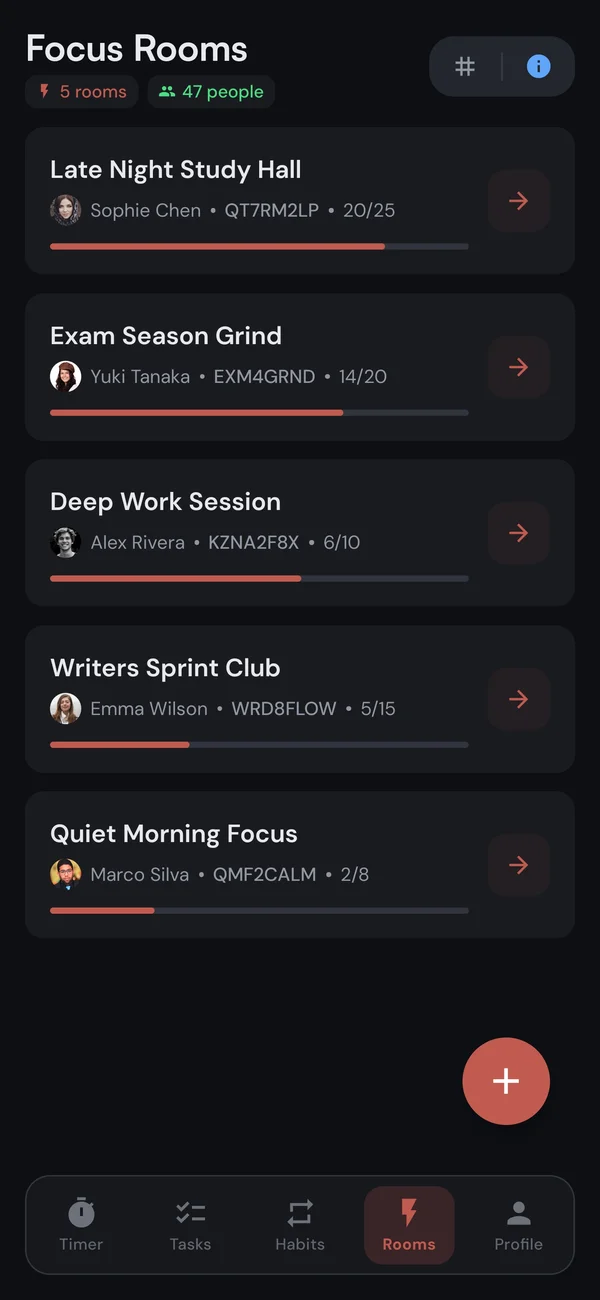
A Focus Room is a shared space where everyone runs their own timer and can see who is heads-down. It works like a quiet library table: nobody is watching you, but everybody is there.

Body doubling
Presence without being watched
Working on your own task while someone else works on theirs is called body doubling. People who do it say it makes tasks easier to start and harder to abandon, and a 220-person survey found most were at least somewhat more likely to finish a task with someone else there. Most apps built on the idea put you on camera. Focus Rooms keep the presence and drop the video: you see that eleven people are focusing, and they see that you are too.

How it works
Three steps, no setup
1. Join or create
Pick a public room from the list, or open your own and share its code.
2. Start your timer
Your status flips to Focusing. Everyone in the room sees it, and you see theirs.
3. Stay present
Take breaks with the room, and keep the app open. Presence is the whole point.
Presence
Real status, real accountability
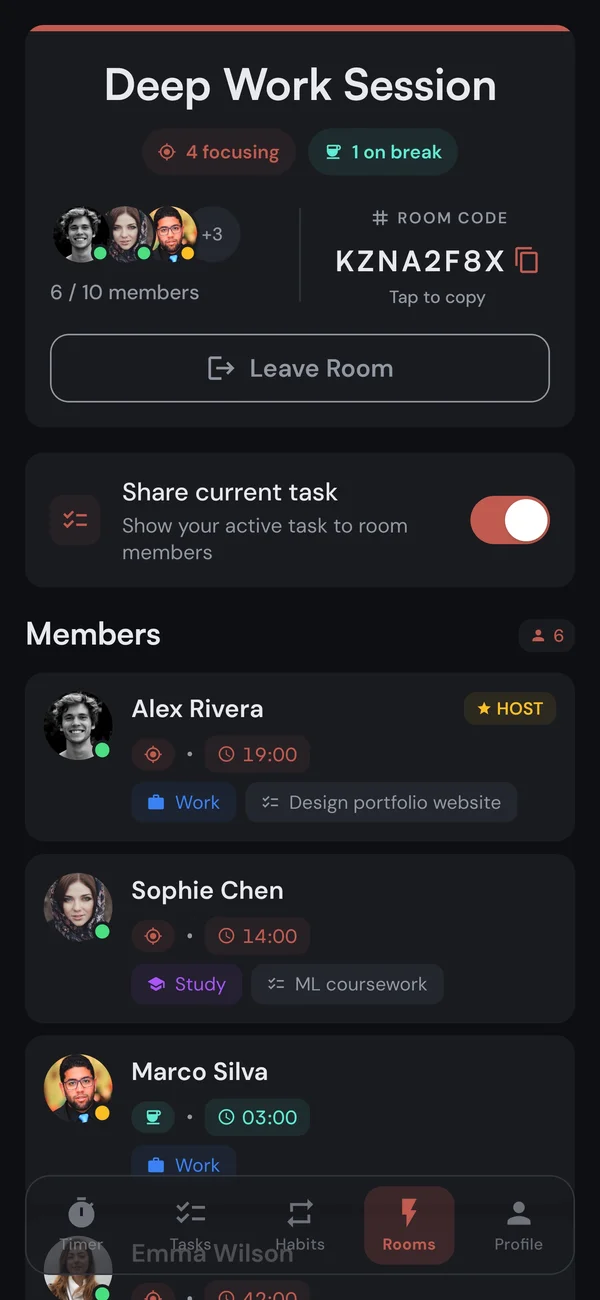
Everyone in the room shows one of six states, plus the tag they are focusing under, so you can see what the room is working on. No task names unless you choose to share them, no video, no audio.
- Six live statesFocusing, short break, long break, paused, away, or idle, with each person's countdown ticking live.
- Your tag, not your taskThe room sees Study or Writing next to your name. The task title only if you turn on sharing.
- Gone after 15 minutesLeave Kaizen in the background for more than 15 minutes and the room removes you. The pressure only works if everyone is actually present.
FocusingShort breakLong breakPausedAwayIdle
Study with friends
Your own room, one code away
Public rooms are for company. Private rooms are for your people: a study group, a writing circle, a remote team doing a Pomodoro together. One person creates the room on Premium and everyone else joins for free with the code. Task sharing shows the room what each person is working on, straight from the task list.
- One code, everyone inYour room has an 8-character code. Share it in the group chat and friends join for free, no Premium needed on their side.
- Public or privateOpen the room to anyone browsing, or keep it to the people who have the code.
- Show what you are onTurn on task sharing and the room sees "Chapter 4 notes" next to your tag.
- Host controlsRename the room, change its size, remove someone, or hand hosting to another member.

Compared
How Focus Rooms compare with video coworking
Focusmate, StudyStream, and Flow Club all sell presence over video, and if being seen is what gets you working, they are good at it. Focus Rooms are the option for everyone who wants to know someone is there without a webcam. Checked on September 2, 2026.
Scroll sideways to see the whole table.
| Tool | Camera | Format | Free | Paid |
|---|---|---|---|---|
| Kaizen Focus Rooms iOS, Android, web, Windows | Never | Drop-in rooms of 2 to 50, each on their own timer | Any room, no session limit | €3.99/mo to create rooms |
| Focusmate Browser | Required | Booked 1:1 slots of 25, 50, or 75 min with a stranger | 3 sessions a week | $8/mo yearly, $12/mo monthly |
| StudyStream Web, iOS, Android | Built around video | Drop-in video rooms of hundreds, 24/7 | Yes, limits not published | Premium about $7/mo |
| Flow Club Browser, built for a computer | Encouraged | Booked, hosted groups of up to 9, 30 min to 3 h | Trial only | $40/mo or $400/yr |
The research
What the evidence says, and what it doesn't
Body doubling comes out of ADHD coaching, and the largest survey of it we could find, 220 people in 2024, found that most were at least somewhat more likely to finish a task with someone else there. The same researchers noted that nearly every commercial tool sits in the high-interaction, shared-space corner of their map, that "not everyone always benefits from that approach," and that video calls can set off social anxiety. Nobody has proven body doubling makes you more productive. What people consistently report is that it makes work easier to start. That is the claim Focus Rooms are built on, and the only one we make.
Made for
Who Focus Rooms are for
Students grinding through exam season
Remote workers missing the office hum
Writers and creators pushing past a block
Anyone whose focus needs a little company
So far
Since launch, in numbers
Kaizen launched in January 2026. As of September 2026, more than 4,000 people have signed up, and together they have logged over 16,500 hours of focus, about 2,500 of them inside a Focus Room with someone else.
Questions
The short answers
Pull up a chair
Joining rooms is free, public or private. Create your own with Premium.